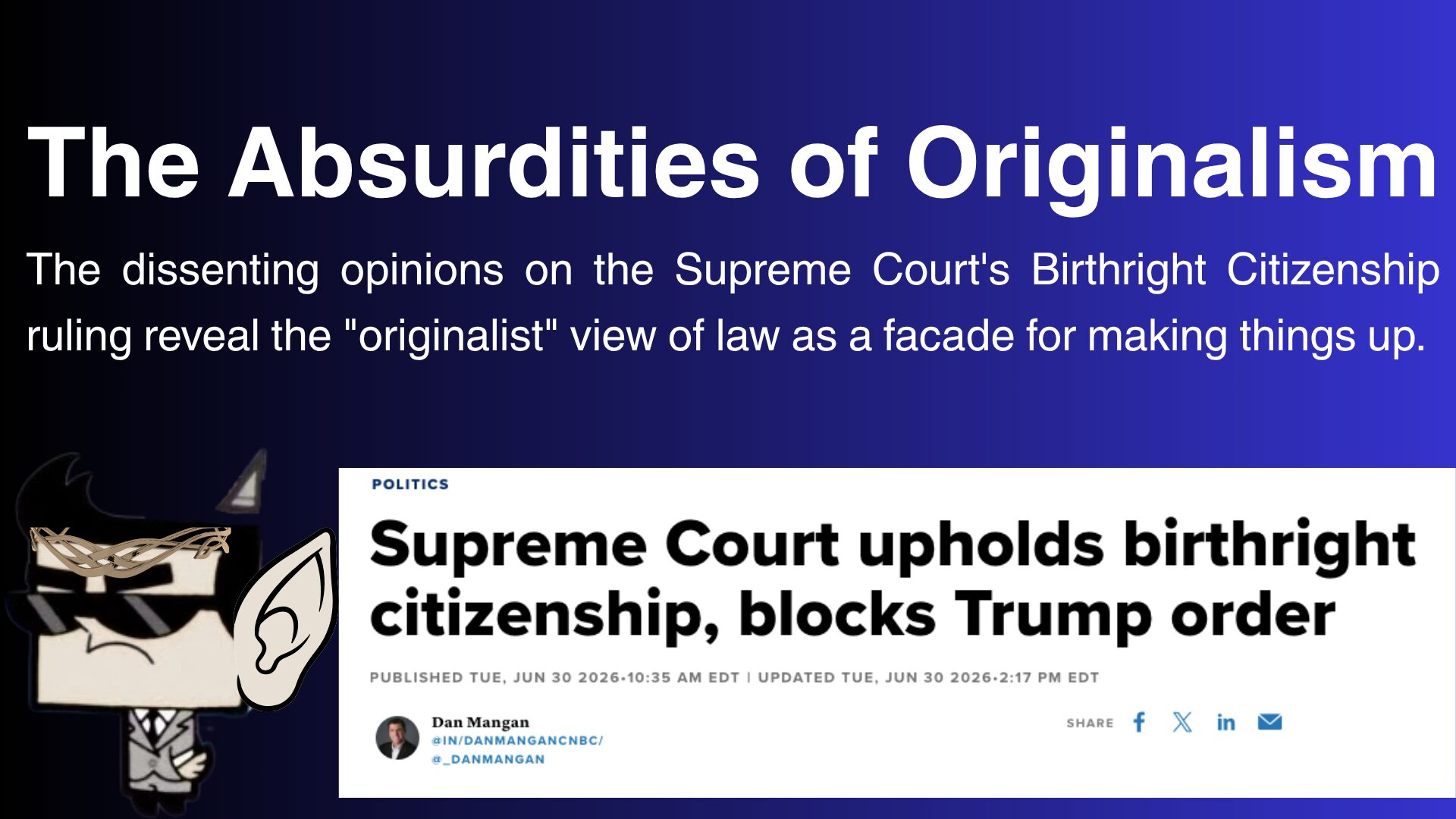
The dissenting opinions on the Supreme Court’s Birthright Citizenship ruling reveal the “originalist” view of law as a facade for making things up.
So over the past few days, since the Supreme Court’s Trump v Barbara ruling reaffirmed the constitutionality of birthright citizenship by reading the 14th Amendment again (but slowly), you may have seen some quotes like this floating around on social media:
“This amendment which I have offered is simply declaratory of what I regard as the law of the land already, that every person born within the limits of the United States, and subject to their jurisdiction, is by virtue of natural law and national law a citizen of the United States. This will not, of course, include persons born in the United States who are foreigners, aliens, who belong to the families of ambassadors or foreign ministers accredited to the Government of the United States, but will include every other class of persons. It settles the great question of citizenship and removes all doubt as to what persons are or are not citizens of the United States.” – Sen. Jacob Howard (R-MI) during congressional debate over the 14th Amendment
In some of the posts I found recycling this quote, the part that the MAGA-aligned posters were interested in was highlighted: “this will not, of course, include persons born in the United States who are foreigners, aliens…”. And in fact, the Trump regime’s own solicitors used this and similar quotes as the basis for their court case, and the dissenters on the court, especially long-winded wind-bag Clarence Thomas, cited such quotes in their written dissents.
There are some contextual issues here, specifically, the contortion of part of this statement and the denial of every other part of that statement — “foreigners, aliens, who belong to the families of ambassadors or foreign ministers accredited to the Government of the United States, but will include every other class of persons”. How one interprets this statement, beyond their political bias and choosing what they wish to see, really hinges on the use of some commas here. The “originalist” conservatives who sided with Trump and against the court’s majority are choosing to read this sentence as a list. Foreigners OR aliens OR people who belong to the families of ambassadors, etc. Each group is named distinctly, and is each group is excluded from the intention of the 14th amendment, in their view.
Whereas the other interpretation reads this as a kind of stammer, a restatement of the same group. The foreigners and “aliens” in question are the children of ambassadors and ministers present in the US, who clearly have strong, foreign allegiances, who would likely want their children to be citizens of their own countries, and whom the US might not want to be citizens of our own. And the “every other class of persons” includes literally everyone else.
And it’s important to clarify here that the immigration system was nigh on non-existent at this point. If you were white, you could just show up and walk in. Under the Naturalization Act of 1790, any “Free white person” could be naturalized as a US citizen after a few years of residency (first 2, then 5, then briefly 14, then back to 5) and being of “good character”. Ellis Island didn’t open until 1892, and it wasn’t until much later that there was a universal customs system to sift people coming in from abroad. So one of the biggest things missing from the “originalist” analysis is the basic awareness of how someone like Senator Howard would have been thinking about immigration.
In 1868, when the 14th Amendment was written and ratified, the US was in the middle of its largest wave of immigration from Ireland. Some cities like New York quarantined incoming Irish folks, but for the most part, their entry into the country was unrestricted. It was understood that nearly the entirety of the Irish immigrant population intended to be naturalized once they had met the residency requirement, and expected their children born on US soil to be US citizens, and even prior to the 14th Amendment they were. That context makes it a lot more clear who Senator Howard is talking about when he says “foreigners and aliens”. He’s talking about people here temporarily who intend to return home, not people with permanent residency.
There were no green cards or temporary residency systems in place at that point. You could just come here and reside, and eventually become a citizen, and our modern systems complicate this by creating a third group, a group who is capable of residing “illegally”, because the threshold for legal residency has risen so dramatically and has become quite expensive and time consuming. But there was no concept of “illegal residency” in 1868, and Senator Howard probably would have stared at you blankly if you tried to hit him with this argument. He would not even understand what you were talking about, because he was working within a very different legal framework.
This is a good example of how the whole premise of constitutional “originalism”, a way of interpreting the constitution which fixates on documents and case law external to the constitution as evidence of “intent” and “meaning” of the statutes within the constitution, is absurd. For one, Howard’s statement, which was given as part of congressional debate, and thus spoken and written down by a stenographer, is not the law. Even if it was unambiguous, and he had said anyone foreign born or their children under any circumstances do not qualify for birthright citizenship under the 14th Amendment, but the amendment passed with the wording it has now anyway, Senator Howard would just be a liar. Because it doesn’t say that explicitly in the amendment, and anyone else in the debate would be just as free to argue that the amendment cannot mean that if it does not state it explicitly.
And this should be very basic stuff, because there aren’t other areas of law where this kind of intent-mining from external, conflicting sources would ever matter. If a parent draws up a will, which states that one child gets the house and the other gets the money, it does no good for the child getting the money to go digging through old emails to show that one time the parent said they wanted that child to get the house. That was before the will was drafted and notarized. The parent made a decision, locked that decision in by legal means, and whatever debates or discussions transpired prior to that point are totally irrelevant once that notary seal hits the paper.
Debate over an amendment has basically the same principles. If someone falsely stated the scope of the amendment to manipulate the public and their fellow representatives, that does not change the text. If someone didn’t understand the scope of the amendment or couldn’t foresee contradictions in the text of the amendment, and argued its function incorrectly, that does not change the text. In fact, Howard’s foray into this territory in the debate is damning to the originalist line here, considering the amendment ultimately never even uses words like “immigrant”, “foreigner”, or “alien”. They talked about these implications, there was consideration given on this subject, and yet no language on this subject appears in the text, and 2/3rds of both Congress and the states voted to ratify the amendment.
Even if the originalists were right, and Howard was handwaving the idea that immigrants need even be considered in this context, then he and the other authors who believed their “intent” was so clear made a massive mistake by not codifying here, on at least some basic level, what kind immigrant they thought applied and what kind they didn’t. The lack of any of this language in the final text of section one of the 14th Amendment is the most damning evidence of all that Howard and the other congressional leaders who drafted this text didn’t think the subject was an issue. And yet the originalist line of Thomas and Alito basically flips this on its head, pretending it can be assumed that the authors of the amendment so clearly didn’t think immigrants counted that they didn’t even see a need in clarifying this point in writing.
In this sense, the “judicial pragmatists”, and their idea of a “living constitution” is more fitting, as they try to interpret statutes fit new conditions, which have no clear constitutional foundations. But judicial pragmatism and originalism are kind of like mirror images of one another, and what they share is an unwillingness to admit that the US Constitution might be a living one, but it’s on its deathbed now. These approaches to viewing constitutional questions are ways to avoid the harsher reality, that we struggle to apply the US Constitution because it is not sufficient or even especially relevant to modern problems.
And for most Americans, digging through James Madison’s drawers for undiscovered letters and contorting clauses of the constitution into having new meanings is much more sensible, and far less painful, than having to admit that the real problem is that we don’t have any consensus in society on basically any element of the constitution. If we had to pass each clause again, line by line, I don’t think 99% of the constitution would survive. The state of the Supreme Court and debates in constitutional law quietly reflect this discord in the society.
In a show I made last year called A Matter of Will, I talked about one of these “judicial pragmatist” approaches in a case called Grant’s Pass vs Johnson, which rejected a suit claiming that bans on public camping violated the 4th Amendment’s “cruel and unusual punishment” clause. Unlike in Trump v Barbara, I thought the suit was well-intended and that the court’s minority dissenters were morally in the right, but I found their argument to be equally hollow. Cruel and unusual punishment is about how people are sentenced. The application of a law cannot itself be cruel or unusual, and there isn’t another good constitutional argument against the public camping law.
The “judicial pragmatist” approach looks at the constitution as a document that contains all the answers, if you can twist things enough, but Grant’s Pass v Johnson proves that this method of denialism has limits, just as Trump v Barbara has demonstrated for originalism. The constitution fails not only the homeless, it fails everyone without property, and even most of the people with only a little bit of property, and it does so on purpose. And when this charade collapses, that’s who the new constitution should be written for — the property-less, the voiceless, and the downtrodden.
You can find A Matter of Will below or on Youtube on my channel (@elrondhubbard42069), in partnership with Community Broadcasting Network, who you can also find on YouTube and online at communitybroadcasting.network. Please check us out on social media as well, I’m active on Facebook, Instagram, and Threads, as well as on here, so please like/share/subscribe to help boost the channel!
Leave a Reply